
 Available in GB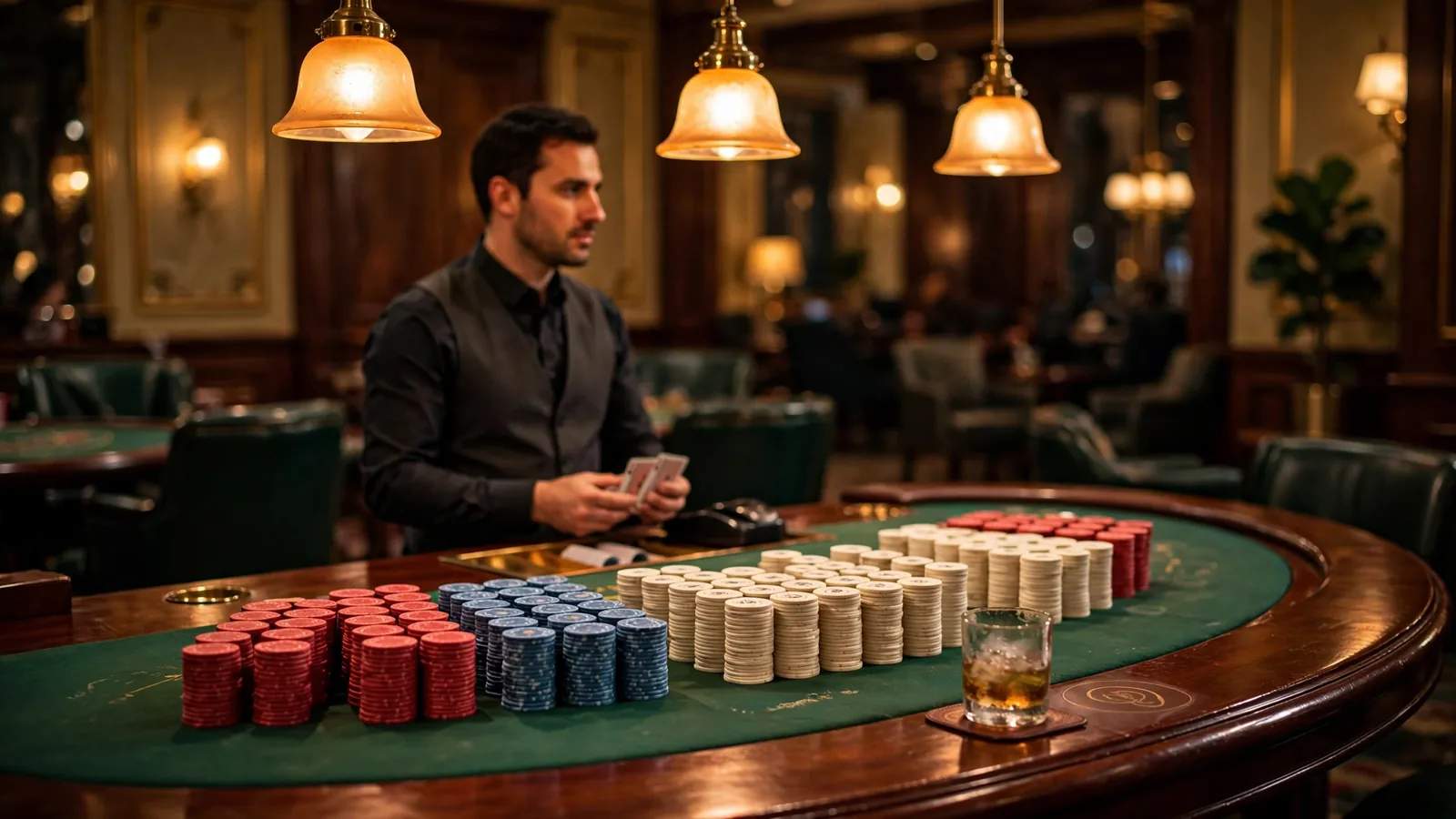
- What Makes a UK Blackjack Casino a Licensed One
- The Difference Between a Good Choice and a Brand Claim
- At the Live Table: Dealer, Camera and Pace
- How a Blackjack Hand Unfolds—and What Winning Can Mean
- Blackjack Among the Live Casino Games
- Getting from Account to Live Blackjack Table
- Strategy Meets the Limits of Certainty
- Live Blackjack in the UK in 2026: A Changing Table
- Bonuses, Payment Routes and the Fine Print
- Blackjack Rules—and the Slot Limits That Do Not Apply
A practical guide to licensing, live-table mechanics, hand outcomes, payments and the limits of blackjack strategy in the UK.
What Makes a UK Blackjack Casino a Licensed One
A blackjack table can look much the same on a screen whether its operator is accountable to British regulators or not. The distinction lies behind the felt: in the legal permission to offer gambling, and in the authority responsible for supervising that permission. A polished interface is not a licence.
In Great Britain, commercial gambling is regulated by the UK Gambling Commission, which is the sole regulator for that activity. Its remit includes remote gambling offered to consumers in Great Britain, including online casino games. The operator’s location, or the place where the equipment running a game is kept, does not remove the requirement to hold the relevant Commission licence when serving this market.
That principle matters to anyone looking at blackjack online. A business may present itself as a casino, publish a familiar-looking brand and make a game available through a website, but those features do not establish that it is entitled to offer gambling to British customers. The Commission issues operating licences to businesses and personal licences to individuals who perform relevant roles. For a player, the central question is whether the business operating the casino has the appropriate operating permission.
The legal framework is not a decorative layer added to an otherwise private transaction. The Gambling Act 2005 governs gambling in England, Wales and Scotland, while Northern Ireland has a different legal framework. Within Great Britain, remote operators selling gambling to consumers must be licensed by the Commission. A blackjack casino serving this market therefore sits within a public system of oversight, rather than acquiring legitimacy through its own description of itself.
The public register is where that claim can be checked. Before depositing, the operator’s licence number should be verified against the UK Gambling Commission register. The point is not merely to see a number printed on a site. A number displayed by a business is still a statement made by that business; the register provides an independent reference against which the statement can be tested. The operator’s identity should correspond with the registered business, rather than relying on a similar brand name or a reassuring badge.
Casino Games in the UK: Slots, Live Games and More
This distinction between a company and the name above its virtual door can be easy to overlook. Brands may be memorable; legal entities are often less so. Yet the licence attaches to the operator authorised to provide the gambling service, not to the general impression created by a logo, a slogan or a blackjack table streamed into a browser. A public record gives the claim a place outside the operator’s own marketing.
The Commission’s reach over remote gambling also answers a common misconception: that an operator can avoid British requirements simply by locating its key equipment elsewhere. For remote services offered to Great Britain consumers, geography does not displace the licensing obligation. The relevant relationship is with the market being served, not just the address of a server or studio.
Checking the register before a deposit is therefore a practical act of verification, not an exercise in legal formalities. It tests whether the business behind a blackjack site appears within the regulator’s licensing system and whether its public claim has an independent counterpart. If the details do not match, or the business cannot be identified there, a confident presentation should not be treated as a substitute for authorisation.
This is also why the phrase “UK blackjack casino” needs more than a national flag or a British-facing page to carry meaning. For a legal online casino serving Great Britain, a current operating licence from the Gambling Commission is part of the basic condition of doing business. The regulator’s role is not to certify that every hand will be satisfying or every result favourable. Gambling remains uncertain. Its role is to regulate the commercial activity and the operators offering it.
The register cannot make a game harmless, and a licence cannot turn chance into certainty. It does establish whether an operator is within the local regulatory framework—a difference more consequential than the finish of the table or the confidence of the dealer’s voice. Only gamble what can be afforded to lose. A licence is a threshold, not an invitation.
DO
- Verify the operator’s licence via the UK Gambling Commission register.
- Match the registered business name to the operator’s identity.
- Check the existence of clear complaint routes and dispute resolution.
- Use available tools for self-exclusion and account-level controls.
DON’T
- Rely on a brand name or logo as proof of authorisation.
- Assume a website is legal just because it is British-facing.
- Trust promotional claims about being the “best” without independent evidence.
- Ignore the discrepancy between marketing and the public register.
The Difference Between a Good Choice and a Brand Claim
A casino can call itself the best place to play blackjack; that is a statement about its own image, not independent evidence of how it is regulated or what happens when a customer has a problem. The distinction matters because polished presentation can make a claim feel settled before it has been checked. A sound assessment begins with records and procedures, not adjectives.
The public Gambling Commission register is one place where a claim can be tested. A dated check of the register, on 26 September 2026, did not identify a LuckyPays entry under that brand or the stated domain, including luckypays.io. That is a specific result from a particular date, not a timeless verdict about every business using a similar name. Names and corporate arrangements can change, so the relevant question is whether the operator behind the actual site can be matched to a current register entry. A brand’s own assurance is not a substitute for that match.
The register is useful precisely because it is not written as advertising. It records regulatory information, while a casino’s homepage is designed to persuade. When those two sources appear to disagree, the discrepancy deserves attention before money is deposited. A site may display familiar symbols, use confident language about safety, or describe itself as British-facing; none of those details establishes that the business holds the required authorisation. The name on the register, the company behind the service and the site being used need to make sense together.
That does not mean every good choice can be reduced to a single badge. A licence indicates that an operator sits within the relevant regulatory system; it does not turn every feature into a recommendation, nor does it promise a particular experience or outcome at the table. The word “best” is especially slippery. It may refer to design, a promotion, a selection of tables or simply the operator’s preferred description of itself. Without a stated and verifiable basis, it is branding.
Live Casino Lightning Roulette in the UK: How It Works
Complaints arrangements offer a more practical test of what lies behind the brand. A UK Gambling Commission licensee must have an internal process for complaints and provide access to an approved Alternative Dispute Resolution service. The existence of these routes can be checked in the operator’s published terms or help material. Their purpose is not to make disagreement disappear; it is to give it a defined path beyond an exchange of promotional assurances. If information about how to complain is hard to find, that is a useful observation in its own right.
Responsible-gambling provisions should be treated with the same seriousness. Licensed casinos must offer tools including self-exclusion, and account-level controls should be accessible rather than buried beneath layers of menus. Their presence does not prove that a casino is suitable for every person, but it shows whether the operator provides mechanisms intended to limit or stop play. A responsible service is not defined by a reassuring slogan alone. The controls have to exist, and their operation should be explained plainly.
A comparison of blackjack casinos, then, need not become a league table. It can instead ask a sequence of concrete questions: does the operator’s identity correspond with a current entry on the public register; are complaint routes set out; are the required support and self-exclusion tools visible and usable? These checks say more than an unsupported claim to be the best online casino for blackjack. They also keep distinct matters distinct: a lively table or attractive presentation cannot answer a regulatory question, while a register entry cannot establish that a particular table will suit a player.
There is a civic detail in this paperwork. Commercial gambling is not left to the vocabulary chosen by the businesses selling it; in Great Britain, a public regulator maintains a register against which claims can be tested. That arrangement makes verification possible, though it does not perform the verification on anyone’s behalf. Trust is not a graphic on a page. It is a trail that can be followed.
Live Baccarat Online Casinos in the UK: Trust and Play
The same caution applies when a result is unfavourable. A register check records what appears under particular names and domains on a particular date; it should not be inflated into a broader claim that the record cannot support. In the LuckyPays example, the dated register search did not show the brand or stated domain. That is reason to pause and seek a clear, matching explanation, not to treat marketing language as proof of authorisation. The distinction is modest, but consequential.
Ultimately, a good choice is less a crowned winner than an operator whose claims withstand ordinary scrutiny. The register can test licensing claims; published procedures can show whether complaints and safeguards have an actual route. Neither guarantees a good result at blackjack, and neither should be presented as doing so. The table may be dressed for spectacle. The evidence should be plain.
At the Live Table: Dealer, Camera and Pace
A live blackjack table has a person at its centre. The dealer handles the cards in view of a camera, while the game reaches players through a stream and the controls for placing wagers sit on screen. It is still an online casino, but its performance is borrowed from the room: hands are dealt in real time, rather than represented solely by software animation.
That difference changes the texture of play. A dealer’s gestures, pauses and brief exchanges give the table a human rhythm. The camera makes the cards and procedure visible; it also makes the experience feel observed, though not quite social in the ordinary sense. Other participants may appear as names or small windows, depending on the platform. The dealer remains the shared point of attention, a familiar figure in an arrangement where the players are physically elsewhere.
The result is neither a private game nor a gathering around felt. It is a broadcast with rules. A player chooses when to take part through the interface, while the dealer carries the visible sequence forward. The stream has a pace of its own: cards must be handled, decisions made and the next round prepared. That can feel more measured than a game that moves at the speed of a button press. It can also mean waiting. Human presence is not a synonym for haste.
Keno online casino UK: rules, odds and claims
The camera matters because it turns procedure into part of the spectacle. A card is not merely a symbol appearing on a screen; it is handled, placed and shown. The arrangement offers a view of the table, not an invitation to assume that every detail of the wider casino is visible. What appears is a framed performance, shaped by the broadcast and its interface. The dealer’s calm repetition is part of its appeal: a small ceremony repeated until it becomes familiar.
There is an older British casino history behind that format. Grosvenor first unveiled live casino games in 2013, bringing a range of card and casino games to its online offering. Blackjack was among them, alongside Texas Hold’em and Roulette. The significance lies less in a claim that the format began everywhere at once than in the fact that a major British casino name placed a live table within its online setting. A known casino ritual had acquired a screen and a remote audience.
That transition preserves some conventions while changing the room around them. At a physical table, the dealer and players share air, sound and attention; online, the camera selects what can be seen and the software organises participation. The dealer’s presence gives the game a human face, but the table remains mediated. It is a useful distinction: live does not mean unfiltered, and a familiar setting on screen does not reproduce the whole social world of a casino.
For some, the attraction is precisely this middle ground. The game is not reduced to abstract graphics, yet there is no need to travel to a venue or sit among strangers. For others, the broadcast can feel formal, or simply slower than they want. Neither response says much about skill; both describe a preference for pace and company, even when that company is mostly implied.
The real-money setting deserves its plainest caution. A live dealer and a polished camera do not soften the financial risk, nor turn chance into certainty. Only gamble what can be afforded to lose. The ceremony is not protection.
Progressive Slots Online in the UK: How Jackpots Work
How a Blackjack Hand Unfolds—and What Winning Can Mean
A blackjack hand begins with a wager and a small interval of suspense: cards arrive, the player sees a hand taking shape, and a decision follows. The aim is to finish closer to the game’s target than the dealer without going beyond it. That simple contest gives the hand its familiar tension. Each new card may improve a total, or make it impossible to continue.
A player can ask for another card, often called a hit, or stand on the hand already held. The choice is made with incomplete knowledge. Some of the dealer’s cards may be visible, but the full picture is not. A hand that looks modest can become strong; a promising one can be spoiled by a draw. The player’s decision is therefore not a forecast of what must happen, but a response to what is known at that moment.
Once the player has finished, the dealer completes the hand under the table’s rules. The totals are then compared. If a hand has gone beyond the target, it loses; if neither side has done so, the higher valid total wins. A tie may be treated differently from a win, so the table’s stated terms matter. The same broad outline applies online, though a live dealer brings the cards, pauses and decisions into view through a camera.
“Winning” can mean more than one thing in ordinary conversation. It may mean taking a hand, ending a session ahead, or receiving a return after a successful result. Those are not interchangeable. A hand can be won while the wider session still finishes down, and a run of favourable results says nothing certain about the next deal. The game offers outcomes, not assurances.
That distinction matters because blackjack’s decisions can feel unusually personal. A player chooses whether to take another card, then watches the consequence appear in real time. When the choice succeeds, it is tempting to credit skill; when it fails, the same decision can look foolish in retrospect. But the result does not rewrite what was knowable beforehand. Chance remains part of the hand, even when the player is active throughout it.
Attention Only gamble with money that you can afford to lose. The game is a matter of chance, and the results are not guaranteed.
The possibility of a good decision is not a promise of a good result. Nor does a loss prove that every decision was poor. A hand is brief; money can carry its consequences beyond the table. For that reason, anyone who plays should gamble only what they can afford to lose. The wager should be money whose loss does not disturb rent, bills, food or other essential commitments.
There is a small social history in this ritual of choice. Casino games turn uncertainty into an orderly performance: a wager is placed, options are offered, and a result is declared. Blackjack makes the player’s part especially visible. Yet the tidy sequence can give chance the appearance of obedience. It is not. The hand ends; uncertainty does not.
Blackjack Among the Live Casino Games
A live casino menu gives blackjack company. It places the familiar card table beside other forms of casino play, making the range itself part of the attraction: different games bring different rhythms, rituals and expectations, even when they share a room on screen.
Grosvenor’s live casino launch in 2013 included Blackjack, Texas Hold’em and Roulette among its card and casino games. That small cross-section shows how blackjack sits within a broader arrangement. Texas Hold’em is another card game, while roulette belongs to a different tradition of casino play. The menu does not make them interchangeable; it brings distinct kinds of play under one live-casino roof.
That distinction matters because blackjack can be the centre of attention without being the whole experience. A player drawn to cards may find more than one route through a live menu, while roulette offers a change of form. The games speak to different habits: following cards, watching a wheel, or moving between tables. A casino’s selection is therefore not merely a count of titles. It is a picture of the choices the operator has assembled.
Blackjack’s place in that picture is unusually legible. Its name is widely recognised, and its table format sits comfortably alongside other established casino games. That familiarity can make it an easy point of entry into a live menu, though it says nothing about whether a particular session will suit someone or how it will end. A broad selection is not a measure of value, either. More options can mean more variety, but they do not turn chance into certainty.
Fast Payout Online Casinos in the UK: What to Check
The live format also lends the menu a social shape. Games are presented as tables rather than as a single uninterrupted stream of outcomes; each has its own setting and pace. The result is a kind of digital casino floor, arranged through screens instead of corridors. Blackjack remains one table among several, not a separate category of entertainment insulated from the rest.
That is a modest historical detail, but a revealing one. When Grosvenor introduced its live games, the combination already joined blackjack with another card game and a casino game built around a wheel. The selection suggests an effort to recreate breadth, not simply to put a dealer in front of a camera. The table was part of a larger scene.
For anyone considering that scene, variety is best treated as context rather than invitation to keep moving between games. A changing menu can make a casino feel expansive; it cannot make wagering harmless. Only money that can be afforded to lose should be gambled.
Getting from Account to Live Blackjack Table
The route to an online blackjack table begins before the table appears on screen. An account has to be opened, and the operator must verify the customer’s age before allowing any deposit. That check is a condition of access, not an optional formality to be postponed until a winning hand makes the account interesting.
Once the account is set up, the deposit stage brings a separate pause. Remote operators must prompt new customers to set a financial limit before their first deposit. The limit is meant to put a boundary around spending while the account is still new, rather than leave the decision until play is under way. Account-level controls must also remain accessible, so limits can be reviewed and adjusted through the account rather than buried beyond reach.
The sequence is deliberately administrative: create the account, complete the age check, set a financial limit, then proceed to funding and the games area. A live blackjack table is one destination within that process, not a shortcut around it. Account menus may place limit settings among other safer-gambling controls; their practical value depends on being easy to find when circumstances change. Good controls are not decorative.
Classic Slots Online in the UK: Reels, Rules and Play
Some casinos may also display a free-play option. Where it is available, it can offer a way to explore a game without treating it as a funded session; its availability and terms are set by the operator. The distinction matters. A practice mode does not remove the checks attached to a real-money account, and it should not be mistaken for a route to withdrawable winnings.
The account is also where a player can take a break from gambling. UK-licensed casinos must provide responsible-gambling tools, including self-exclusion, and GAMSTOP offers a national self-exclusion service. Those controls belong near the practical business of signing in, not in the small print after a session has become difficult to stop.
The point of setup is not to make play frictionless at any cost. A little friction can protect the boundary between an evening’s entertainment and an expense that lingers. Live blackjack remains gambling, however polished the interface or familiar the dealer’s voice. Only gamble what can be afforded to lose.
Strategy Meets the Limits of Certainty
A blackjack strategy is a way of organising decisions, not a method for making uncertainty disappear. It can help a player act consistently rather than letting the mood of a previous result dictate the next choice. That distinction matters in a game where a carefully considered decision may still end badly, while a careless one may happen to pay.
Casino blackjack strategies often begin with a chart: a compact guide to choices under stated rules. Such a chart can make the logic of a decision easier to inspect, but it is not a prediction of what the dealer will reveal. Nor is it universal. Table rules and options affect which choices are recommended, so a guide copied from a different game may be less useful than it appears. Preparation has limits.
That is particularly relevant online. A player may have a chart beside a live table, but the broadcast’s human presence can make each decision feel more immediate. The dealer continues the procedure; the camera gives the pauses and gestures a social texture. None of that changes the odds. A blackjack strategy for an online casino is still a framework for selecting among permitted actions, not a reading of the dealer’s expression or a secret signal hidden in the pace of the game.
Fast Payout Online Casinos in the UK: What to Check
Strategy also has a quieter purpose: it can put boundaries around attention. A pre-decided approach leaves less room for chasing a loss with an impulsive change of plan or treating a run of wins as evidence that luck has become obedient. It cannot prevent every emotional decision. It can, however, make the difference between choosing deliberately and simply reacting.
The language of “systems” often suggests that a clever sequence can turn gambling into reliable income. That promise confuses discipline with control. A sound decision does not guarantee a favourable result, and a favourable result does not prove that the decision was sound. Luck is not a performance review.
The most measured casino blackjack strategy is therefore modest about what it can achieve. It may support clearer choices and steadier play; it cannot remove chance or make losses impossible. Money set aside for gambling remains at risk, whatever the quality of the plan. Only gamble what can be afforded to lose.
Live Blackjack in the UK in 2026: A Changing Table
In 2026, live blackjack online in the UK sits between an old social ritual and a screen-based service. Its cards and decisions belong to a familiar casino game; its presentation borrows from broadcasting, with a dealer and a camera making a distant table feel present. The format changes how the game is encountered, not what a hand can promise. Chance remains stubbornly untelevised.
That distinction matters in a market where “live casino” can describe quite different things. Blackjack centres on a card table and a sequence of choices. Roulette turns on a wheel and a ball; game-show formats such as Crazy Time or Dream Catcher wrap chance in a more theatrical frame. These are not interchangeable experiences simply because they share a screen. The appeal of live blackjack lies partly in watching a recognisable procedure unfold, rather than in spectacle alone.
The table’s changing character is therefore less a story of rules being replaced than of setting being recast. A casino once gathered players around a physical room; an online stream brings the dealer’s gestures and the dealt cards into separate homes. The social space becomes narrower and more private. The audience may be dispersed, but the performance still depends on someone dealing, waiting and responding in real time.
French Roulette Online in UK Casinos: Rules and Odds
There is a small cultural irony here: technology has made a solitary screen imitate a public room. Yet the imitation is not the same as companionship. A live dealer gives the game a human presence, not a guarantee of conversation, atmosphere or favourable outcomes. In that sense, the format is honest about what it can show and limited in what it can supply.
For anyone considering a blackjack casino online, the year in the heading should be read as a time marker, not a prediction that the game has become safer, more profitable or fundamentally different. The central facts of the experience remain simple: a live presentation surrounds a game of chance, and the screen cannot remove uncertainty. A measured approach matters more than the novelty of the feed. Only gamble what can be afforded to lose.
Bonuses, Payment Routes and the Fine Print
A blackjack promotion can look generous in its headline and restrictive in its terms. The distinction matters whether it is described as a casino bonus for blackjack, a welcome offer, or a no-deposit promotion. The label does not explain what games qualify, whether bonus funds can be used at live tables, or what conditions apply before any resulting balance can be withdrawn. Those details belong to the terms, not the banner.
A no-deposit offer should not be read as money without conditions. Its rules may specify which games count, how winnings are treated, and what must happen before a withdrawal is permitted. A bonus attached to a deposit raises a separate question: which parts of the offer depend on depositing, and what happens if the promotion is declined? The answers are operator-specific. Where the terms are unclear, the advertised value tells little.
Promotions and payment methods also need separate scrutiny. An offer does not make every funding route lawful or suitable. Remote gambling operators cannot accept credit-card payments for gambling. The restriction also covers credit-card funds routed through a money service business, and a wallet cannot be used for gambling where it allows credit-card funds to be spent that way. A payment method’s familiar name does not settle the question; the source of the funds matters.
That boundary reflects a public policy choice: borrowing should not be turned into a routine way to fund gambling. It is less dazzling than a promotional headline, but more consequential.
Progressive Jackpot Slots: How They Work
The practical check is therefore twofold: read the offer’s conditions independently of the payment page, then consider whether the chosen funding method is permitted for gambling. A blackjack bonus offer should not be treated as evidence that a particular payment route is acceptable, nor should a permitted route make an unclear promotion worthwhile.
Promotions can make play feel like an opportunity to stretch a balance. They do not change the uncertainty of the game, and a bonus is not income. Only gamble what can be afforded to lose.
Blackjack Rules—and the Slot Limits That Do Not Apply
Blackjack rules set the framework for what each card is worth, which choices are available to a player and how the dealer must act. The table’s rule display matters: it explains the conditions under which a hand is played and settled. That framework is shared across casino versions, though particular tables can differ in their stated rules. The rules govern the game; they do not turn its outcome into a certainty.
A point that is easy to miss is that online slot restrictions are not a general ceiling for every casino game. A specialist gambling review states that Great Britain’s online slot stake limits are £5 per game cycle for adults aged 25 and over, and £2 for adults aged 18 to 24. The same kind of review distinguishes those limits from roulette and blackjack: neither game is covered by the slot stake cap.
The distinction follows the category of game, not the appearance of the screen. A roulette wheel may be streamed from a studio, and a blackjack table may be dealt by a live dealer, but that presentation does not make either one an online slot. The limit described for slots concerns a slot game cycle; it should not be carried across to a different casino game simply because all are available through the same account.
Blackjack’s own rules still matter. They tell players how decisions are made and how the table resolves a hand, while the applicable regulatory category determines which specific restrictions attach to the game. Those are related questions, but not the same one.
The distinction is narrow, not a general statement that blackjack has no rules or protections. It means only that the Great Britain online slot stake limits described above do not apply to blackjack or roulette. A game’s rule sheet and its regulatory treatment answer different questions. The table has its rules. The category has its limits.
Are online casino games licensed and regulated?
Yes. In Great Britain, operators offering remote casino gambling to consumers must hold the relevant UK Gambling Commission licence.
What are the online slot stake limits in Great Britain?
The limit is £5 per game cycle for adults aged 25 and over and £2 for adults aged 18 to 24. These limits do not apply to roulette or blackjack.
What are the differences between UK-licensed and non-UK regulated online casinos?
A UK-licensed operator serving Great Britain holds authorisation from the UK Gambling Commission and falls within its regulatory framework. A casino regulated elsewhere is not thereby shown to hold the UK licence required to offer gambling to consumers in Great Britain.
How do I check if an online casino is licensed in the UK?
Check the operator’s licence number against the UK Gambling Commission’s public register. Match the registered business to the company operating the site; a licence number or badge displayed on the casino’s own website is not independent verification.