
 Available in GB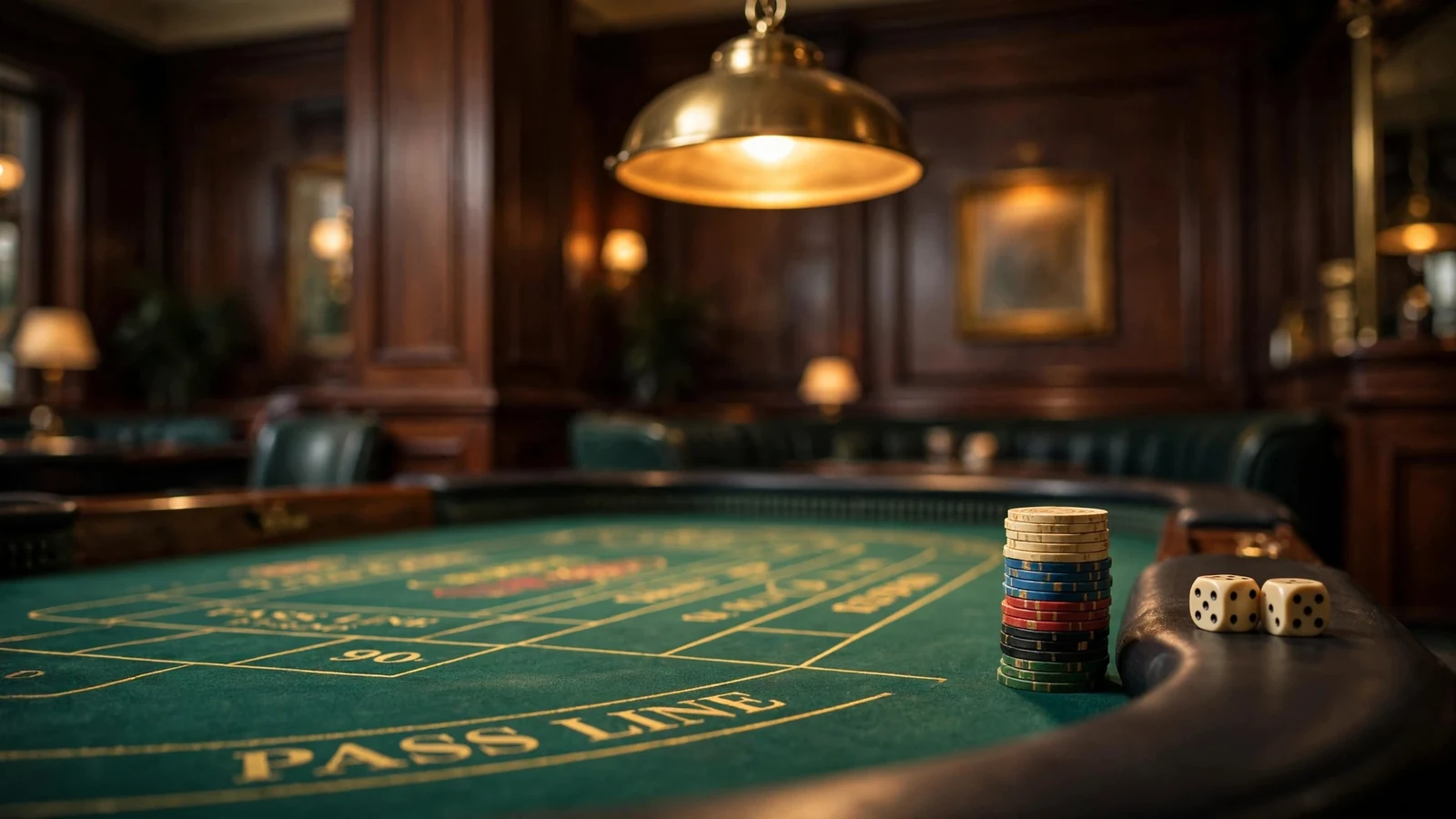
- Real-Money Craps and the Operator Behind the Table
- What a UK Craps Casino Listing Can—and Cannot—Establish
- Assessing Online Craps Sites Without an Unsupported ‘Best’ List
- Craps Table Choices and the Decisions They Put in Play
- Free Craps Play: Practice Without a Cash Stake
- Learning the Shape of a Craps Round
- Live Dealers, Crypto Payments and the UK Protection Question
- Craps House Edge: A Figure That Needs a Specific Bet
- Winning Odds Depend on the Bet, Not the Search Phrase
- Reading the Craps Chip Layout Before Placing a Bet
A practical guide to real-money and free craps, operator responsibilities, table options, bets and the limits of casino listings.
Real-Money Craps and the Operator Behind the Table
A craps table becomes a real-money offer not because its graphics look convincing or its dice roll across a digital felt, but because money can enter the game and winnings can leave it. That distinction is easy to blur in a casino lobby, where free demonstrations and cash play may sit behind similar tiles. Yet the practical questions are different: whether a stake is being taken, how a balance is funded, and which business is responsible for returning money that is due.
A free version can show the appearance of a casino craps game without creating a cash balance or a claim to cash winnings. Real-money play connects the game to an account, a deposit and a process for withdrawing funds. Those steps belong to the operator’s service, not to the look of the table. A polished interface says little about who controls the account or how the transaction works.
That division is clearer in the software business. Amatic Industries is an Austrian business-to-business supplier, not a consumer-facing casino. It supplies games to operators, while the operator handles player deposits, payouts, bonus terms and customer support. Its UK Gambling Software (Remote) licence, held since 2017, authorises software supply; it does not make Amatic the counterparty for a player’s cash. A supplier’s name on a game is not the name to look for when asking who holds the balance.
Amatic Casinos in the UK: How Game Access Works
The distinction matters even when a game is presented as part of a casino’s own lobby. A studio can create the software; another business can provide the account and cashier. For craps, the same test applies in principle: the table’s maker and the casino operator may be different entities. But identifying a supplier alone would not establish that a particular casino offers craps for cash. The operator’s own offer is what would need to make that plain.
An intelligible real-money offer should connect the table to the cashier in ordinary language. It should identify how deposits are accepted, what conditions attach to them, how withdrawals are requested and what terms govern any promotional funds. It should also make clear whether the amount shown in the game is cash, bonus credit or merely a practice balance. These are not decorative details. They define what a player can do with the account and what obligations accompany a transaction.
Slot Providers: UK Casino Game Studio Guide · IGT Online Casinos in the UK: What Can Be Verified
Payout language deserves particular care. A displayed win is not, by itself, an explanation of how funds become withdrawable. The operator’s terms should distinguish a game result from the movement of money out of the account, and state any conditions that apply. Where a bonus is involved, its rules may affect whether associated winnings can be withdrawn immediately. A headline amount without its conditions is only half a description.
The word “cash” can also give a free game an undeserved air of consequence. A practice table may imitate a wager while using points that cannot be deposited or withdrawn. Conversely, a real-money table may be reached through a familiar game screen, with the financial distinction placed in account terms rather than the visual design. The screen is theatrical; the account is contractual.
That is why claims about real-money online craps need to be tied to a named operator and an actual cashier, not inferred from a game title or a software logo. Amatic’s role shows how far the name on a game can be from the business handling a player’s funds. It does not, by itself, establish a craps table or a cash offer. A supplier is not a cashier.
There is a small social history in this separation. Casinos have long depended on several kinds of labour and ownership: the people who devise a game, the businesses that provide a venue, and those who account for the money. Online, the walls disappear and the responsibilities can seem to disappear with them. They have not. The screen merely compresses them into one lobby.
For anyone assessing a cash offer, the essential account is therefore not whether a casino page uses the word “craps”, but whether the operator clearly explains the route from deposit to play and from a win to a withdrawal. A game can be vivid while its financial terms remain obscure. The reverse is possible, too: a plainly described cashier can sit behind an unremarkable table. The money trail matters more than the felt.
A supplier’s name on a game is not the name to look for when asking who holds the balance. The operator handles player deposits, payouts, and customer support.
What a UK Craps Casino Listing Can—and Cannot—Establish
A casino described as a UK craps site may be presented as relevant to British players, but the description itself is not evidence of regulatory status. A listing is an editorial label: it says how a publisher has grouped or characterised a site. A UKGC licence is a legal authorisation held by a business. Those are different kinds of statement, and one does not prove the other.
That distinction matters because a website can be accessible from Britain without being authorised to offer remote gambling to people there. The relevant question is not where a casino’s servers, offices or owners happen to be, but whether the business offering gambling to consumers in Great Britain holds the required licence. The Gambling Commission’s remit follows the market being served, not the physical location of the equipment.
The UK Gambling Commission oversees gambling activity in the UK, including online casinos. In Great Britain, it is the regulator responsible for commercial gambling. Its role is not limited to casinos with a particular game in their menus: it concerns the gambling activity and the businesses offering it. A page that calls itself a UK craps casino therefore cannot substitute for evidence that the operator is within that system.
Amatic Online Casinos in the UK: Who Runs Them?
A game label is not a licence
Craps is a casino game, but seeing its name in a description or promotional page establishes only that the page makes that claim. It does not establish that the site is licensed, that the named operator is the entity holding the licence, or that the offering is available under a UKGC licence. Even an accurate description of a game tells nothing by itself about the legal status of the company making it available.
The reverse distinction is just as important. A company’s UKGC licence does not, by itself, confirm that a particular game appears in its current catalogue. Licensing and game availability are separate questions. One concerns permission to provide regulated gambling; the other concerns what a particular operator has chosen to make available. Treating either as proof of the other turns a useful label into a misleading shortcut.
The Commission issues operating licences to businesses and personal licences to individuals working in relevant roles. These are not interchangeable credentials. A business licence speaks to the operator’s authority to provide gambling; a personal licence relates to an individual. A name or badge on a page is not enough to tell which entity holds which permission, or whether the permission covers the activity being offered.
The boundary follows the customer market
For remote gambling offered to consumers in Great Britain, the Commission’s oversight applies regardless of where the key equipment is located. That principle prevents geography from becoming a convenient disguise: moving technical infrastructure abroad does not, on its own, remove the licensing requirement when the service is being offered into the British market.
Regulatory Status
A listing is an editorial label and does not prove an operator holds a UKGC licence. Always check the Gambling Commission’s records for legal authorisation.
This is why the phrase “UK casino” needs careful reading. It might mean a casino that accepts customers in Britain, a site written for a British audience, or simply a page using UK-oriented language. Only the first description raises the substantive question of whether the operator is properly authorised to serve that market. The wording is not the answer.
The distinction is regulatory, not a verdict on the quality of a game or the appearance of a site. A polished page, familiar currency symbols or a menu that names craps cannot confer a licence. Nor does a listing become an official entry because it appears in a directory. Editorial categories are made by publishers; regulatory permissions are issued by the regulator.
What the description leaves unresolved
A listing can help identify a site someone wants to investigate. It cannot, without further evidence, establish that the operator holds the relevant UKGC licence or that the licence belongs to the business actually taking customers. It also cannot establish that a named game is currently offered under that operator’s service. Those are distinct claims, requiring distinct confirmation.
For a British-facing casino, the meaningful regulatory check is against the Gambling Commission’s records, using the operator’s legal identity rather than relying on a trading name alone. A licence held by a software supplier, an individual, or another company in a wider group is not automatically the operating licence of the casino presented on a page. Names matter. So does the capacity in which a licence is held.
This is a relatively unromantic way to approach a casino listing. Yet regulation exists precisely because the language of commerce is elastic: “UK” can describe an audience, a brand position or a market, while a licence describes a formal authorisation. The two may coincide, but a heading cannot make them coincide.
Amatic Online Casinos UK: How Game Access Works
A craps casino listing can establish that someone has placed a site in a craps-related category. It cannot establish, on its own, that the business is authorised to offer remote gambling in Great Britain. For that, the operator’s licence—not the label—has to carry the weight.
Assessing Online Craps Sites Without an Unsupported ‘Best’ List
A ranking of casinos is only as useful as the comparison behind it. For craps, the first question is not which site has the grandest welcome banner or the longest games menu, but whether a particular casino currently offers a craps game at all. A casino’s general interest in table games does not establish that it has craps; a search result, old review or broad category label may describe something that has since changed.
That makes a confident list of the best online craps casinos in the UK a claim requiring current, specific evidence. Without it, naming operators would turn a guess into a recommendation. The careful answer is less theatrical: compare only sites whose actual craps offering can be checked, and do not treat a casino’s name in a list as proof of quality.
Start with the game, not the brand
The catalogue is the basic test. A useful assessment would establish that craps appears in the operator’s own games area and can be opened there, rather than relying on a third party’s description. Even then, a title being visible at one moment does not necessarily mean it will remain available. Game libraries can change, and a catalogue page can lag behind what is playable.
Checking Availability
- Verify the game appears in the operator’s own games area
- Confirm the specific title is currently playable
- Check if the game is automated or a different format
- Read the game’s own information panel for rules
The distinction matters because “casino with table games” is a roomy phrase. It may refer to a collection of games that has nothing to do with craps. A listing that uses the word without showing the title, its format or its current availability offers little basis for choosing a site. The small print of a catalogue is more revealing than the grand claim.
A sound comparison would also record what kind of craps experience is actually presented. That means identifying the game or games, and whether the offering is automated or has another format, rather than assuming that every result labelled online craps describes the same thing. The details should come from the casino’s own display, not from a familiar brand name doing the work of evidence.
Compare what can be observed
Once availability is established, practical qualities can be judged without declaring one casino universally superior. Is the game easy to locate? Are its title and provider visible? Does the information panel explain the available options in clear language? Does the game load and remain legible on the device being used? These are observable features, not promises about how often a player will win.
The same discipline applies to presentation. A polished lobby may make a game easier to find, but decoration is not the game itself. A comparison can describe navigation, screen clarity and the availability of rules or help text. It should not convert those impressions into a claim that a site is “best” unless the criteria are stated and the evidence supports the judgement.
Betsoft Online Casinos UK: A Provider Check
A reader assessing online casinos that offer craps would also need to distinguish a real, accessible game from a promotional page or an outdated catalogue entry. A title may be mentioned in an article while absent from the casino’s current lobby. A responsible review dates its checks and says what was observed, rather than allowing a past listing to pass as a present feature.
“Best” depends on the measure
The word best can conceal several different preferences. One person may value a clear interface; another may care most about game selection or how readily the rules can be found. Without a declared measure, a ranking blends personal taste with factual claims and presents the mixture as settled fact.
A useful comparison therefore names its basis. It might assess whether the game is available, how clearly the casino describes it, and how straightforward the route to the table is. Those criteria can support a limited editorial judgement. They cannot establish that a particular casino suits every player, nor can a well-designed lobby settle questions about the game itself.
There is also a difference between describing an individual site and claiming it is the best online casino for craps in the country. The first can rest on specific observations. The second implies a comparison across a defined field, made on consistent terms. If the field is not established or the same checks have not been applied to each operator, the ranking is more confident than its method.
Comparison Standard
A trustworthy ranking must be based on verifiable game availability and specific, dated observations rather than broad editorial labels.
A shortlist needs maintenance
A comparison of craps casinos is not a permanent directory. Availability can change, pages can be reorganised, and a game that was once listed may no longer appear. Any shortlist worth trusting needs a clear date and a fresh check of each entry. Otherwise, it records an earlier state of a casino’s catalogue while sounding current.
The same care is needed with review language. “Popular”, “top-rated” and “recommended” can sound like measurements while leaving the reader unable to tell what was measured, by whom, or when. A more useful account separates direct observations from opinions: the game was present in the lobby; the rules panel was accessible; the interface was readable on a stated device. That is modest, but it gives the comparison somewhere solid to stand.
For now, the honest standard for finding the best craps casino is not a string of familiar operator names. It is a verifiable game, a transparent method and a comparison that says what it can actually support. Anything less is a league table without a league. Dry ground.
Craps Table Choices and the Decisions They Put in Play
A craps table can look like a place where everything happens at once: a roll, a call, a cluster of wagers and a changing set of possible decisions. That impression is part of its social theatre. Yet a player choosing a wager is not simply joining the noise. Each choice has a name, a place in the game’s sequence and conditions that need to be understood before money is committed.
Amatic Games in UK Casinos: How They Work
The names themselves can suggest more certainty than they provide. Labels such as Pass Line, Don’t Pass, Come and Field are familiar in craps discussions, but a label is not a full explanation of what a wager does. Its meaning depends on the game’s rules and the point at which the wager is made. The useful question is not merely what a bet is called, but what event settles it, when it can be placed and whether the displayed rules impose any further conditions.
That is less glamorous than a tip. It is also more useful.
A sensible way to approach any unfamiliar table is to treat its help panel and betting information as part of the game, not as small print to be hurried past. A clear description should identify the wager, explain when it is available and say what result counts as a win or loss. If the wording leaves those points uncertain, confidence cannot fill the gap. A casino interface may borrow the language of a physical table while arranging its controls differently; the rules displayed for that particular game are what matter.
Craps tips often arrive packaged as instructions: back one side, avoid another, add a wager after a particular event. Such advice can sound like a recipe, but it may depend on rules or a sequence that has not been explained. A tip without its conditions is only a fragment. It cannot establish that a wager is suitable, that it will remain available, or that its treatment matches another game carrying the same name.
Do
- Read the help panel and betting information
- Identify the specific event that settles a wager
- Confirm the rules for wins and losses
Don’t
- Rely on nicknames or unverified tips
- Assume all games with the same name have the same rules
- Hurry past the small print of the betting terms
Nor does a string of confident recommendations turn chance into a dependable method. A decision can be deliberate without being predictive. The distinction matters in a game whose public face is made of calls, gestures and shared attention. A crowded table can make every choice feel socially confirmed; an online table can reproduce the labels and rhythm without supplying that social knowledge. Neither atmosphere explains the terms.
Before selecting anything, it helps to separate three questions that promotional language often blends together. What is the wager called? What must happen for it to be settled in the player’s favour? What happens if the relevant result does not occur? These are questions about the contract between the game and the bet, not about a supposedly superior way to play. If the rules do not answer them plainly, the decision is not yet informed.
There is also a difference between learning the vocabulary and learning a strategy. Recognising a term can help make a table less forbidding; it does not prove that the associated wager is advantageous. Advice framed as “best” may conceal the assumptions on which it rests, while a simple explanation of conditions is more modest and more transferable. The table does not reward a label merely because it sounds familiar.
The same care applies to buttons that offer a quick repeat or invite another wager. Convenience is not an argument for taking a position. A repeated choice may carry forward an earlier decision, while a new one may introduce different terms; the interface should make that distinction legible. If it does not, hesitation is reasonable. The machine’s pace is not a rule of the game.
ELK Studios Casinos in the UK: Finding Available Games
Craps rewards attention to language before attention to ceremony. Terms should be read in context, tips should be tested against the stated rules, and no wager should be treated as self-explanatory simply because it appears on a familiar-looking table. That approach cannot promise a result. It can prevent a more ordinary mistake: placing a bet whose meaning was never clear.
Free Craps Play: Practice Without a Cash Stake
A free version of craps can mean several different things: a demonstration that uses virtual credits, a promotional play mode, or a game whose title contains “free” while access still depends on an account or other conditions. The label alone settles very little. What matters is whether money is required to start, whether the credits can be replenished only without payment, and whether anything won can be withdrawn as cash.
That distinction is easy to overlook because a screen can resemble a casino table in either mode. Virtual chips may make the experience feel consequential; they do not become money merely by being displayed with convincing ceremony. Equally, “free” does not necessarily mean that every route into the game is free. An account requirement, a deposit condition or promotional terms can change the practical meaning of the offer.
Bubble craps raises the same question in a different costume. The word describes a style of presentation, not by itself a promise that the game is available without a cash stake. A title or lobby label cannot establish whether the play is a no-cost demonstration, a real-money game, or something conditional on an account. The mode and its terms need to be clear before the game is treated as practice.
Attention The term "free" can be misleading; ensure that no deposit is required and that winnings cannot be converted to cash if you seek a true practice session.
For a genuinely no-cash session, the useful checks are plain: whether a deposit is required, whether any virtual balance can be bought, whether the game accepts real-money wagers, and whether winnings have any cash value. If the terms are unclear, “free” is a description to investigate, not a complete explanation. Promotional credits also differ from ordinary demo credits: attached conditions can determine whether they can be used, and whether a resulting balance can be withdrawn.
There is a small social history in this distinction. Gambling has long borrowed the language of play, while commercial offers give that language a price-bearing edge. A practice mode removes the cash stake only if the conditions really do; a familiar table layout cannot do that work on its own. No money at risk is a meaningful boundary.
In Britain, real-money online gambling is legal only through an operator holding a UKGC licence. That does not turn every no-cost demonstration into a cash game, nor does a free label establish who provides it. The operator and the terms remain relevant, especially where a free mode sits beside deposit-based play.
Free play can help someone become familiar with a game’s presentation, but it should not be mistaken for evidence about cash play. The same screen may serve different purposes, and the wording around it matters more than its appearance. A modest distinction. A useful one.
Habanero Online Casinos in the UK: What to Check
Learning the Shape of a Craps Round
For someone new to craps, the first difficulty is often not a particular wager but the table’s apparent busyness. Several areas are marked out, chips move, and the game advances through stages. Yet a screen full of activity is not the same thing as a clear explanation. Learning the round means identifying what the game says is happening before trying to follow what each player is doing.
The most reliable guide is the game’s own rules and help panel. It should explain how a round begins, what event changes its state, when a wager can be placed or removed, and what ends the round. Those are the landmarks that make the sequence intelligible. Without them, a flashing result or a changing display can be mistaken for a rule when it may simply be animation.
A useful habit is to read one stage at a time. First, establish what the table calls the opening state. Then note what the game says happens after the roll, and how that affects the next stage. Finally, look for the stated condition that settles the round. The exact terms matter: a label on the layout may have a precise meaning in that particular game, while ordinary words such as “win” or “lose” can obscure which wager is being described.
This is not a shortcut to choosing bets, nor a substitute for understanding them. It is a way to keep the game’s sequence separate from its options. The table layout and wager names deserve their own attention; they need not be memorised before the basic flow makes sense.
Understanding the Round
To learn the sequence of a craps round, follow these steps:
- Identify the opening state of the table.
- Note the event that occurs after the roll.
- Observe how the roll affects the next stage of play.
- Find the stated condition that settles the round.
Online presentation adds another layer. Buttons, prompts and animations can make a game feel self-explanatory, but they do not replace the written rules. If the interface does not make clear whether a round is still open, settled, or waiting for a new decision, pausing to consult its instructions is more useful than guessing from movement on screen.
Craps becomes easier to follow when its stages are treated as a sequence of stated conditions, not as a blur of chips and dice. First the structure. Then the choices.
Live Dealers, Crypto Payments and the UK Protection Question
A live craps table and a crypto payment method raise separate questions. A streamed dealer concerns how a game is presented; cryptocurrency concerns how funds move. Neither feature establishes that a casino is authorised to serve people in Great Britain. The relevant distinction is the operator’s UKGC licence, not the currency displayed at the cashier or the presence of a dealer on screen.
Remote gambling offered to people in Great Britain requires a UKGC licence even when the operator’s equipment or business is based elsewhere. Offshore casinos sit outside that system. They may be reachable, but they do not thereby acquire UK oversight, UK complaint routes or the protections attached to a licensed operator. For British customers, legality rests on the operator holding the appropriate UKGC licence. A digital coin changes no part of that test.
The available reporting on Amatic games did not confirm a UKGC-licensed operator accepting cryptocurrency for those titles; that finding appeared in a specialist review and should be treated as a report about Amatic, not as a rule about every casino or a finding about craps. Amatic itself is a software supplier, not a consumer-facing casino. Its catalogue includes random-number-generated table games, but no live-dealer games. A supplier’s licence to provide software is not a casino’s permission to take deposits.
Isoftbet Casinos in the UK: Games and Availability
That distinction matters when a site pairs crypto with live dice games. The combination can make a venue look like a single offering, while the game provider, payment route and gambling operator remain different things. Only the operator’s own status determines whether the service is licensed for the British market. A foreign licence does not substitute for a UKGC licence.
Live presentation can lend a table the atmosphere of a room; crypto can make the cashier feel technically distant from ordinary banking. Neither is a safeguard. The UK framework is less theatrical: it attaches responsibility to the operator. Unromantic, perhaps. Useful, certainly.
Craps House Edge: A Figure That Needs a Specific Bet
A house-edge figure is not a property of a casino game in the abstract. In craps, it would need to be tied to a particular wager and the rules under which that wager is settled. Without those details, a percentage looks precise while saying very little about the table in front of a player.
That distinction matters because a craps table contains different bets, not one uniform stake with one uniform return. A figure presented as the house edge for “craps” may refer to a single bet, a selected group of bets, or an assumed pattern of play. Those are not interchangeable descriptions. The rules and payout terms matter, too; a calculation detached from them cannot reliably describe a particular game.
House Edge Context
A house-edge percentage is only meaningful when tied to a specific wager and a particular set of rules. Without these details, the figure lacks practical context.
Casino listings and promotional copy can flatten that complexity into a headline number. The number may be mathematically correct for a stated wager and ruleset, yet misleading when those qualifications disappear. Precision is not the same as context.
A responsible comparison would identify the wager, the applicable rules and the basis of the calculation before treating any figure as useful. If those particulars are absent, the honest reading is not that every craps table shares the quoted edge. It is that the claim has not established what it measures.
For British players, the regulatory question is separate: a casino offering remote gambling to customers in Great Britain must hold the relevant UKGC licence. That requirement does not, by itself, validate a mathematical claim about a craps bet. Different questions. Different evidence.
Winning Odds Depend on the Bet, Not the Search Phrase
A statement about the odds of winning at craps is incomplete until it identifies what counts as a win. A wager is not the same thing as an entire visit to a table: one bet can succeed while another fails, and the result of a single decision says little about what may happen across repeated play.
That distinction matters because “winning at craps” can mean several things. It might mean the chance that a particular wager pays, the chance of leaving a round ahead, or the chance of ending a longer session with more money than was staked. Those are different questions. A probability for one bet cannot answer all of them.
The wager’s terms and the table’s rules also matter. A figure detached from those details can sound exact while describing no particular situation. That is not a useful shortcut; it is a number without a subject.
Even a properly specified probability is not a forecast of an individual result. It describes likelihood, not a promise about what the next roll or session will bring. Over repeated play, outcomes can vary, and a run of wins does not establish that future bets have become more likely to succeed.
Amatic Online Casinos in the UK: Games and Rules
So claims about the odds of winning craps at a UK casino need to say which bet and which definition of “winning” they refer to. Without that, the phrase gathers several unlike outcomes into one reassuring-looking label. The arithmetic may be precise. The claim is not.
Reading the Craps Chip Layout Before Placing a Bet
A craps table is a map as much as a surface. Its printed areas give wagers separate addresses; the chip’s position, rather than its colour alone, is what is meant to identify a bet. On a screen, that map becomes a set of labelled regions, and a tap or click may place a marker where a hand once did.
That resemblance can be deceptive. A digital layout is an interface, not proof that every table uses the same labels or handles a selection in the same way. The useful habit is to read the wording beside the betting area, check which chip value is selected, and look for any confirmation or summary before a wager is accepted. A marker drifting over a border is not a subtle form of communication.
The distinction matters because table graphics compress rules into space. A label can be familiar while the conditions attached to it are not; the game’s own information panel is more reliable than memory borrowed from another version. If the display does not make clear which area is active, the placement is ambiguous, however polished the felt looks.
In a physical casino, chip placement is visible to the dealer and other players. Online, it is recorded through the interface. The ritual changes; the need for clarity does not. A well-designed table should make the selected wager legible before play proceeds. The felt may be virtual. The meaning still has to be explicit.
What bonuses and free spins are available at Amatic casinos in the UK?
32Red, Betfred and bet365 offer free-spin wins with 0× wagering, so winnings are credited as cash without a playthrough requirement. The bet365 offer requires a £10 lifetime deposit and provides up to 500 spins over 10 days.
How does the UK’s 10× wagering cap affect Amatic casino bonuses?
Since 19 December 2025, wagering requirements on bonus funds at UK-licensed operators cannot exceed 10× the bonus amount. This applies to Amatic games when they are offered by those operators.
What is the new UK slots stake limit and how does it affect Amatic games?
The limit is £5 per game cycle for players aged 25 and over, and £2 for those aged 18 to 24. It applies to online slots, including Amatic games, from 9 April 2025 and 21 May 2025 respectively.
Must a casino be Gambling Commission-licensed to offer Amatic slots to UK players?
Yes. A casino offering remote gambling to consumers in Great Britain must hold the required Gambling Commission licence; Amatic’s software licence does not cover the casino’s deposits, payouts or player accounts.
What is Amatic Industries and when was it founded?
Amatic Industries GmbH is an Austrian business-to-business gaming software supplier, founded in 1993. It supplies games to casino operators and does not run consumer-facing casinos.
Can Amatic slots be played on a mobile phone in the UK?
Yes. Amatic games generally run in a mobile browser as HTML5 games and do not require a download.